Jun 8 2012

GET OFF MY CHEST! Vol.1: Camera Culture

(or: “…the experience isn’t as essential as the record.”)

(we just need to vent a little)

San Franciscan Diane Karagienakos and Seattleite Paul Pearson are the consummate online friends. They have never met in person. They’ve never Skyped or even spoken on the phone. In fact, if not for their mutual connection to exactly two people, they might not have ever known of each other’s existence. But they instant-message each other with a rapport like they’ve been doing this internet thing for a hundred years.

In this new conversation series for the 21st century, Diane and Paul riff on their Facebook IM screens about current events and topics that capture their interest. Here’s the first episode, about the effect instant and frequent photography has on our landscape.

Paul: Hi, Diane!

Diane: Good afternoon, Paul! Enjoying your Sunday?

Paul: Sort of. I was at the LMFAO show last night, and they encourage a lot of drinking. They don’t mention the day after. You?

Diane: Very productive one. I saw a friend in Death of a Salesman last night. It required only one drink after, so I’m clearheaded. That said, I made myself a Bloody Mary for this occasion. Can’t work without tools!

Paul: Excellent. I have a 32-oz. water. You may have to do a lot of the heavy lifting. So you were telling me this great story about moppets the other day.

Diane: I was walking past my corner cafe, during the beer and baby night, with 30-something couples enjoying a kid-friendly happy hour, food truck right outside, etc. (The owners had a kid 3 years ago and now have another on the way — so they clearly tapped into something here). It seems to be a hit — not many other bars in the hood welcome moppets at happy hour.

Two little girls were playing outside while mom & pop enjoy adult beverages on the sidewalk. Their play takes the form of one girl filming the other. The girl being filmed, I hear her say as I pass, “I’m so scared, I’m terrified, please no, don’t…”

And she’d doing some mighty impressive overacting that would make (insert name of lame actress) proud. And something about it bugged me. I flashed back to when I was their age, and play: The slope in our backyard was a mountain. The little gulley between the neighbor’s back wall and the one behind it was a secret cave. Our beagle was my companion shepherd dog. My little woven pouch was… well, my little woven mountain girl pouch. You get the idea. My imagination transformed the landscape, so that I was in a different world, a different person.

And it bothers me in a way I can’t quite put my finger on: is this how middle class American children play now? They “Imagine’ they’re a in a different world, a different person…but a fictional one in a movie/on TV/being viewed/existing purely to be filmed and/or viewed? What about play for play sake? Would their play have existed if there was no camera there?

Or does she just want to be an actress? I know when I was little, I was very clear on Us vs. Them. Ordinary people vs. Movie Stars. I didn’t think about being a movie star. I didn’t think I couldn’t be one; I just didn’t think about it. I guess that’s the American Idolization of the times: Everybody has a chance at fame; or at least being on camera.

Paul: When I was a kid I did something similar to that. Not necessarily “filming with a camera,” but pretending to be in a movie. There’s a scar I’ve had beneath my left nostril that came from my running my Big Wheel into the back of an open pickup truck, because I was trying to emulate something I’d seen in a movie.

But the story you describe is a little different. Was the kid “acting” or pretending to be on “reality TV”? There’s a funny phrase for you – “pretending to be on reality TV.”

Diane: “Pretending to be on reality TV” is your own personal “The medium is the message.” McLuhan would be proud.

Let me ask you this though (because we were big on using the cassette recorder and my my dad was always filming us): Were you actually shooting on film/tape to make a final product, or just emoting in front of a camera for its own sake? I know with these little projects we made as kids, we had a specific product we wanted to make to share with others (or just look back on). We invested time and planning. We worked to get it right! It wasn’t just a time killer, you know?

Paul: I was acting, at least in my head. I tended to do a lot of musicals. I remember my first big musical production on my front porch was a musical based on a theoretical appearance on The Match Game. (Props to the late Richard Dawson, btw.)

Diane: Tell me you have that on tape, please!

Paul: Unfortunately I do not. This was 1972. But it’s interesting in that later on, I would contextualize real events in my life as if they were a movie.

Diane: We did a lot of commercial spoofing. Think an aural Wacky Labels (I think they were called).

Paul: We had film cameras when we were young, and not long after that we had video cameras. But what I think the camera culture that you describe didn’t arise until we got cameras on our phones.

Diane: Exactly. It’s one thing to see adults obsessed with cameras (or phones, as the case may be). There are apps, like Toy Camera, Instagram, and Hipstamatic, now that make those with no photographic training or instinct able to make some really cool images. And it is fun to share them. So that’s cool, it’s a fun new toy.

But it’s overdone. People — myself included — take way more pix than ever because the pix are free and there’s this instant forum for sharing or feedback. I assume kids see parents doing this and think that’s just the way it’s always been, to photograph all the minutiae all the time.

Paul: I think media phenoms tend to emerge more widely the smaller their mediums get — for example, music-wise, we went from vinyl to cassettes and CDs to Mp3.

When I’m at shows — particularly highly visual ones, like last night — cameras are continually hoisted in the air. Even I do it. If, like last night, I’m being accosted by a giant inflatable zebra, I’m inclined to catch the moment.

But getting entire songs on camera, that’s what I’ve never really understood. Your role as a participant in the event shifts from partaking to documentation. I would think something personal would get lost in that transition.

Diane: Tru dat. Remember when we had to pay to develop film? It made us somewhat selective of what we chose worthy of capturing forever. Now we capture it and go “eh, that wasn’t so great I guess.”

Paul: Yes, I remember Fotomat. They were some damn good kiosks.

Diane: It just make me wonder, kids growing up where that’s what they know… The old saying “Stop And Smell The Roses” needs to be updated to “Stop And Photograph The Roses.” It’s no longer about stopping to appreciate all the beauty that surrounds us (and fills all the senses), that is present in any given moment… and that “this too shall pass.” (Which is why I got that tattoo.) It seems folks are now more concerned not with savoring a moment, but with sharing it on social media.

It’s like we’re shortchanging moments and memories. With focusing (literally) on the picture before us, we sacrifice being still and paying attention: to the smells, the sounds of that moment. How it was cold but felt good. The light. How the person with us had an eyelash on his cheek. You get the idea. A picture does paint a thousand words, but it doesn’t capture the unseeable of the story.

Paul: Which maybe wouldn’t be a bad idea if the actual quality of the stuff people share was better. In the Fotomat age, you had to choose your subjects carefully. It involved planning. These days, it’s just editing.

Diane: Amen. So, I have no kids. You do. How are you — or are you — approaching all of this with your children? Because it is pretty philosophical when you get right down to it. Being present. Paying attention. Being appreciative? I honestly think that sort of parenting starts early.

Paul: It’s a little tricky with kids. Lucie, for example — an incredibly gifted and intelligent child, kicking ass scholastically, very mature in a lot of ways for her age. But I think television has affected her ideas of what to expect from life. I think Lucie sees things on TV – like reality shows, the dancing shows, things like that – and thinks those kinds of things are perfectly achievable on an everyday basis with little or no training whatsoever. And I’m terrified that may not be far off from the truth! But logistically, it’s harder. As far as how Kate and I approach it, I think we’ve done a fairly good job of explaining that TV is a depiction of an experience, not the experience itself.

Diane: And so many kids out there are given tools to distract them from their surroundings. Little gizmos to watch videos and play games and tune out. It’s sad to see. I work in a restaurant and it’s sad, as I see it a lot. A family at family dinner, and everyone’s playing with their gizmo. Tuning each other (and their server) out.

At the risk of sounding like judgmental childless woman: how much is it possible to control what she views and how much, and or give it context? I know some parents have a no TV position, which I think is almost mean. You don’t want your kids to be clueless to the world around them. There must be some middle ground…

Paul: It’s time management, mainly. We have to do it ourselves. But giving it context is something we do all the time, because it’s fun to talk about what Lucie sees on TV. She doesn’t really watch stuff we don’t watch, or find completely unbearable. We’ve raised a Barney-free household. Generally, especially when we’re watching baseball or football games, sometimes when we’re watching Food Network shows, we talk about what’s going on.

And I don’t think Kate lets them watch that much TV when they’re home and I’m at work. I think they play a lot of music. I don’t know, ’cause I’m usually not here. Maybe they’re all about QVC when I’m gone.

Getting back to the camera culture, I’m not sure at what point we will think the experience isn’t as essential as the record. “This is the time/And this is the record of the time,” as Laurie Anderson put it.

Diane: “…experience isn’t as essential as the record.” Your second quote-worthy moment of the day!

Paul: Aw shucks, thanks. I teach my children to make memorable quotations. They’re up to Oscar Wilde now.

We used to associate camera culture pretty directly with tourism. You live in perhaps the most tourist-attractive city in the US. Are we trying to inject that adventure into our lives with cameras? A sense that we were only visiting?

Diane: I have an example where the record and the experience became interchangeable — for the better. When my dad was dying, over the month of April 2007, I spent that month with him and my brothers in Las Vegas. It was an emotionally crippling time (and inspired my multi-media play, It Is What It Is). I became aware early on that I needed to take something from that month besides the image of my dying father. I decided to photograph all that was beautiful or interesting or… whatever got my interest. So that I’d have other memories besides his pain and our suffering.

So I started photographing little things. And twice, the pursuit of the shot lead to a story in and of itself that involved peoples and scenes that would never have happened otherwise, yet were completely organic and the memories of which made me happy. It was never about people acting for the camera; merely my need for two particular photographs led to a string of crazy events that created great stories for all involved — I just happened to be the lucky one to have a camera on me as the scenes unfolded. BTW: I never photographed my father during that time. On principle.

Paul: What things were you taking pictures of?

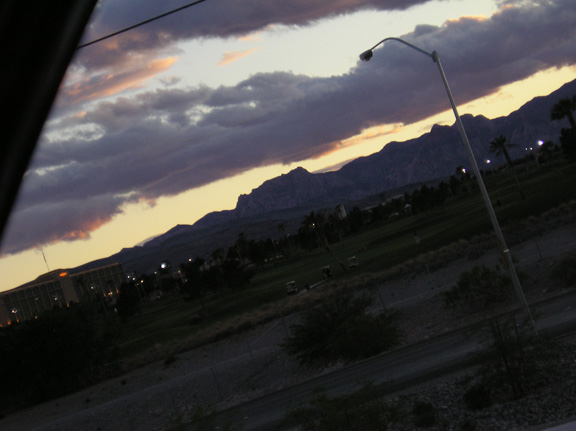
Diane: The mountain ridge that, when I was 5 I guess and my first permanent tooth came in, looked just like that tooth. It’s my touchstone when in Vegas. Where so much has changed, there is one thing that will always be as I remember it: “My Tooth.”

I ran four red lights for this shot. It's a long story.

A blinged-out middle-aged black couple in a ’55 convertible T-bird with not 1 but 2 pairs of fuzzy dice on the RVM (that’s one of the two with a story behind it).

Balloon animals that were left for whatever reason in the fountain of my favorite Mexican Restaurant (Ok, truth be told: we were drunk and threw them there ourselves.)

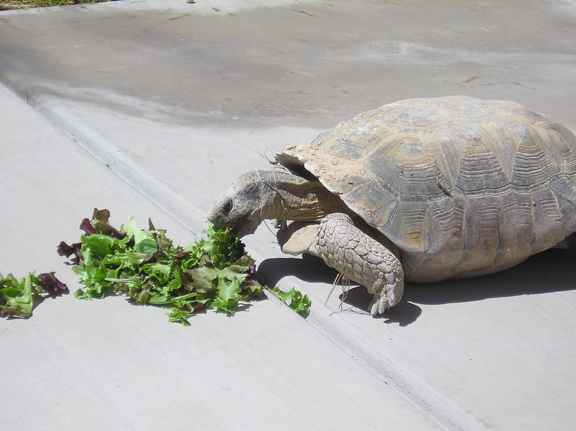
Howard the desert tortoise outside my dad’s room at the hospice center (the second one with a story behind it).

A huge heap of flip flops in my friends back yard — my friend is made crazy by his wife’s clutter everywhere, including 40,000 pairs of flip flops.

And more.

Paul: Now that I can hang with. Images generating ideas. So is what we have an issue with the idea that pictures are now being mass-consumed, instead of generating another activity, memory or art?

Diane: For me, it’s sort of what Warren Beatty said to Madonna in Truth or Dare: What’s the point of doing anything if it’s not in front of the camera? My favorite moment in that movie. What was he even doing with her in his life!?!

Paul: Ha ha! I remember that! She started all this! At this point in our conversation I think it’s appropriate for me to play the Cindy Sherman card.

Diane: Go on…

Paul: I saw one of her exhibitions when I lived in Los Angeles. I was with another person who had a kid. As I recall the kid was a little confused as to why this woman took thousands of pictures of herself and called it “art.” At the time I was too, although I see the bigger picture (ha) now.

This was just before the time when picture-taking really got ubiquitous. She had romantic dalliances with a couple of stars after that – Steve Martin, David Byrne as I recall. And I wondered if her M.O. actually made her into a star of her own, in some weird Warholian way. Did her self-reference actually transform her? Would she have been different if she’d taken, say, the Georgia O’Keeffe or Ansel Adams route? Or even Fran Leibowitz?

Diane: Did you mean Annie Leibowitz? I worship Fran, BTW.

Paul: I didn’t mean Georgia O’Keeffe. And yes I meant Annie. Kate thought I might have meant Georgia O’Keeffe’s husband, Alfred Stieglitz, who was a photographer. But in reality, I simply didn’t know what I was talking about.

Diane: You raise a good point about Miss Sherman, but ultimately I think she a celebrity because her work is art. To have a series of (for lack of a better word) self-portraits and yet have it feel egoless in it is truly amazing. I think some photographers can shoot other subjects, and still somehow their ego is what stands out most. I look at an Annie Leibowitz photo, and the first thing I see in it is her.

Paul: I had to think back on Cindy’s work — you raise a good point that it was surprisingly ego-less. There’s the notion that her just taking pictures of herself and presenting them en masse was an act of egotism in itself. But that cancels out the idea of the content of her work, which was much more fragile than that.

Diane: And to those of you out there who post videos of entire concert songs on Facebook: Wow, neat, got it, you were there, good for you, bet it was cool to watch, but gosh too bad you were too busy filming it to actually watch it. As you can see it’s pretty lame viewing on your smartphone captured video.

Paul: I have to depart. I don’t have a summary statement. I could go on for hours about this. But I do have one admonition, to everyone who’s out there taking pictures of themselves. That’s all fine. But we really have to cut down on the duck faces. I mean the non-ironic ones. But even the ironic ones are getting a little out of hand.

Diane: Will do. It was an honor and a privilege, sir! Don’t let your babies grown up to be reality show celebrities.
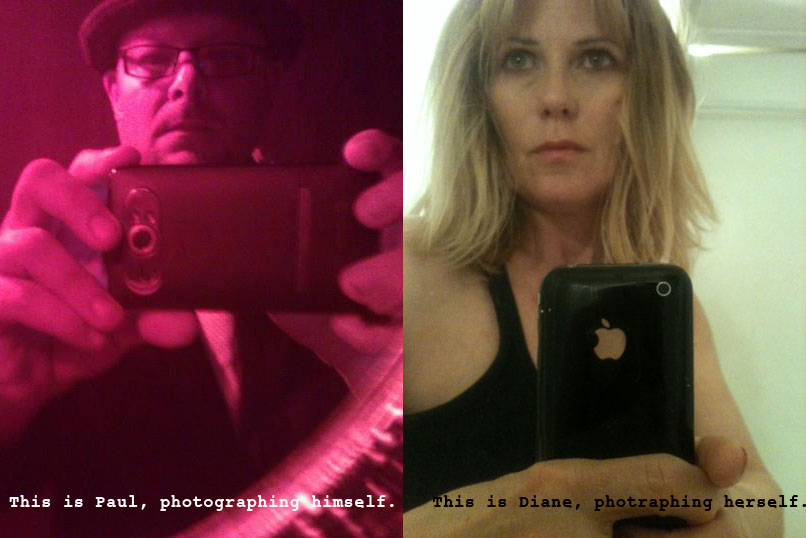
Self portraits seemed like an obvious choice, given the subject matter.
Feb 29 2012

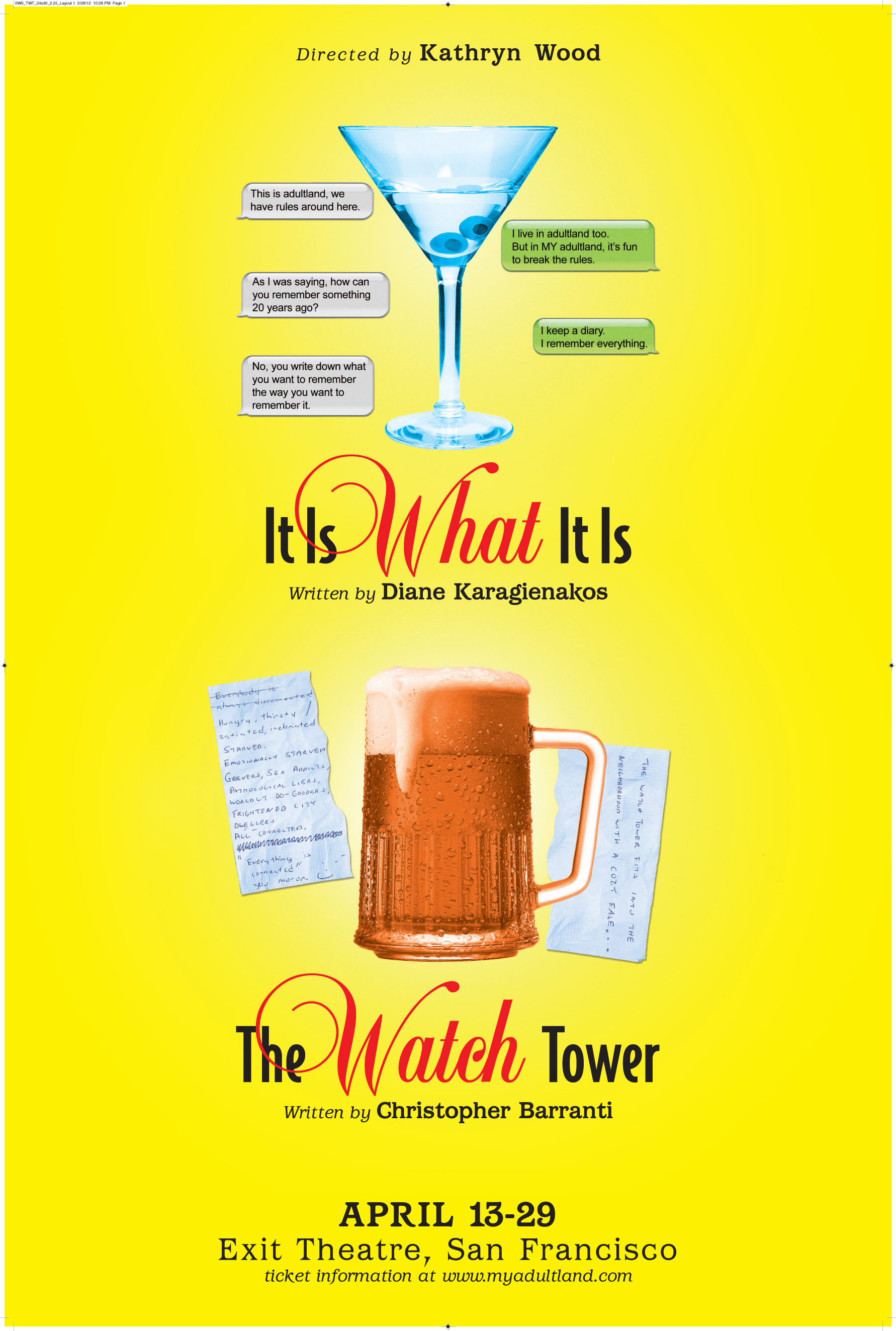
“It Is What It Is” and “The Watch Tower”: Three Weekends. Two Plays. One Price.

Poster Design: Tony Edelstein

San Francisco writers Diane Karagienakos and Christopher Barranti met in a writing group several years ago, helping each other with feedback on their work. Now the two are collaborating at the Exit Theatre April 13-29 with a three-week run of two short plays sharing one stage. The two works, both directed by Kathryn Wood and presented with a short intermission, complement and contrast each other with female/male perspectives on love, death, relationships and sexting.

“It Is What It Is” by Ms. Karagienakos is a multi-layered multimedia meditation on what it really means to connect in today’s hyper-connected world. Estranged siblings brought together around their father’s deathbed struggle with buried issues and simmering conflict. As their father’s condition worsens and spoken dialogue becomes explosive, the audience is given a more complete, and often hysterically funny, perspective thanks to their texts, IMs and emails.

In a classic San Francisco bar room set piece, “The Watch Tower” by Mr. Barranti focuses on the passing revelations and deep insights found among a group of strangers at the bottom of a shot glass on a rainy afternoon. Emotionally starved characters experience an unexpected awakening as their facades are swept under the bar mat. Absurdly humorous, combative and revealing, this new play will be instantly familiar to local audiences.

(Blake Weirs)

Tickets available at www.brownpapertickets.com.

PS: “LIKE” US ON FACEBOOK, PLEASE!


Feb 22 2012

“The pen is mightier than the glass to the head.”

I recently had the honor and great privilege of being interviewed by the frightfully intelligent — and funny! — Paul Pearson: cynosure of all things interesting, musical, poltical, and entertaining. Check it out — check him out — here on his website. We discuss art, technology, communication and, of all things, feelings. All of which tie into the upcoming premier of my play, It Is What It Is.


Feb 21 2012

The backstory of ”ITISWHATITIS”

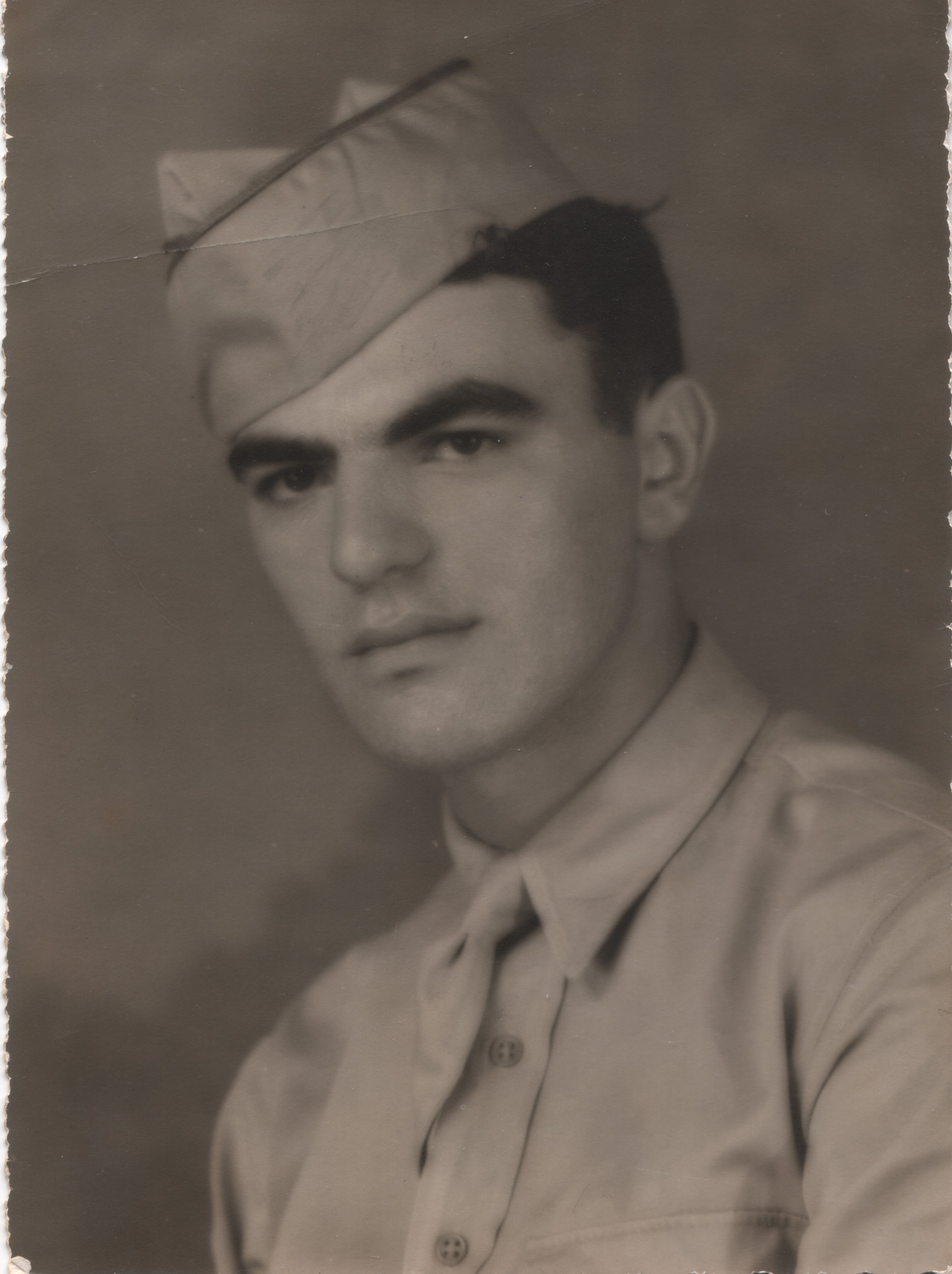
That's my daddy.

My daddy.

My father died in the spring of 2007. I wrote a play about it, It Is What It Is, an abreviated version of which premiered at the 2008 San Francisco Fringe Festival. Below is a bit about the real events that inspired (and were later fictionalized) in the play. There’s a lot of multimedia stuff: texting messaging, emailing, that’s a vital theme in the show: the ways we communicate differently with people depending on the medium. And the ways we communicate (via different media) simultaneously with different people.

So…

What makes the death of my father so unique?

Nothing. He was old, he was infirmed, he was ready. It happens to everyone, it’s the cycle of life, blah blah blah.

That’s the point: it’s universal. There’s nothing magical or mysterious about the death of an elderly parent. But what does make the grief-filled periods magical and mysterious are the little gems: The moments of life-saving levity that get us through the times of greatest gravity.

Several branches of my family were torn apart over issues of money when someone died or was dying. The one thing I learned about myself and my brothers — the one way in which we actually ARE alike — is that we were not going to have any of that. When the time came, everyone stepped up to the plate. No questions asked, no complaints. We did what we had to do for our father. It wasn’t easy. Hell, it downright sucked. And he made it as hard as he possibly could for us.

But that’s who he was: he was a fighter. He really died a month before his heart stopped. He died when he stopped fighting. When he laid there saying “take me god take me god”. When he’d close his eyes hoping, hoping hoping — only to open them and say “Christ, I’m still here”. It was actually very funny, the way he’d say it. I didn’t get my father’s humor as a kid. As an adult, I see him as one of the funniest people who ever lived. He was the the lovechild of Bob Newhart and Jake LaMotta, I guess you could say. Understated, deadpan — and deadly.

But back to those moments of levity.

Dying people say the darndest things. Chalk it up to the anger / denial of it all. Lashing out and hurting their kids is the only power they’ve got left. Everything else, their fate: out of their hands. But they can still terrify their kids into feeling like helpless children again. And thensome.

Some of the greatest things he said during that time:

“You, empty your pockets!” everytime one of us walked in the room. Empty your pockets? Was this something they said when they took someone in a back room when he was a hood growing up on the streets of New York, or something they said when they captured a POW in WWII? Empty your pockets? And he meant it. He wanted us to give back his keys, his money — things I assure you were NOT in our pockets.

He wanted us to call him a taxi and a plane to get him out of there. Taxi: okay. But a plane? A plane?

You wonder what’s going on in their head when they say shit like that. But you know, it’s never the time to ask.

But the best, the all time classic, is when he had the three of us together, tearing us a collective new one. And he blurts out — and I quote — “You’re all male prostitutes, the three of yous”. Now first of all, I’m a woman. Secondly, my brothers — well, let’s just say if they actually WERE male prostitutes, you’d never ever, ever never guess. Maybe I’m wrong.

Oh, and then there was the time when the old guy down the hall took me for a prostitute (female, I assume). I was standing outside my father’s room, on the phone with a friend. I made a point of wearing a dress and looking very pretty everyday I was there, for my daddy. And this old, very lucid-looking guy rolls by in a wheelchair. He’s one of the more spritely guys in this place. He looks at me with them porkchop eyes and says “Hello, pretty lady!” So I, in turn, said “Hello!”

Well, I guess he went to the bingo hall and told some tales. Because 15 minutes later, there’s a knock on the door. No one knocks in this place. I answer it, it’s a different old guy. This one not so lucid. He’s looking at me like I’m the first woman he’s seen since the war who’s not a nurse or in a wheelchair — and he’s not sure what to make of that. Finally he says:

“This 204?”

I didn’t know what the hell he meant at first. Then I realized there was a placard next to the door. My father’s room number. Who knew? It was just the third on the left to us.

“Yes, this is 204.”

“You 204?”

“Um, yeah, I guess that would make me 204.”

“Can I come in?”

“What? No, you can’t come in.”

“Why not?”

“Because I’m in here with my father, that’s why not.”

“Really?”

“Really.”

So… That’s the way it is?”

“Yeah, that’s the way it is.”

“Well, gee. That’s too bad”

And he disappeared down the hall, to the faded tunes of the player piano…

But even after my father gave up the fight, there were still some killer moments in there. He was having one of those “Christ, I’m still here?” afternoons. He asked me what he should do. I told him his options were pretty limited, that he could try holding his breath. So he did. But that just aggrevated his respiratory infection and made him cough uncontolably – apparently he awakened a dormant volcano of dry green mucous in his lungs, and once it started , there was no turning back. Of course he was so dehydrated the stuff wouldn’t move, and he couldn’t really drink liquid, so he’d have to suck on a piece of ice ‘til it melted, let the water loosen up a small amount of phlem, and spit. Repeat. For a good twenty minutes.  I stood there the whole time, spittoon in one hand, towel in the other. I think he coughed up his own bodyweight in mucous.  I asked him to stop holding his breath after that. (fortunately, that scene never made it to the stage).

Or the time I was leaving and he said wistfully “I want to go with you”. I’m pretty sure that my father never had a wistful moment a day in his life before this, so I’m so happy I was there for it. I told him to close his eyes and float out with me. AND HE ACTUALLY DID. Close his eyes, I mean. I hope he floated out with me. You’d have to ask him. But it was so sweet that he tried.

To kill time between these moments actually worth remembering, I started writing them down — just to be sure I’d remember. It’s hard to eat, read, anything when you’re sitting in a nursing home with one crap channel on the TV. That kind of sleep deprivation makes most all activities requiring an iota of concentration moot. Armed with my laptop (and no wifi), I just started jotting things down. Observations. Drafting emails I would later send when I could get online. I also started taking pictures of everything and anything within my day. With one exception: I did not photograph him. He would never want to be remembered that way, and besides, for better or for worse, I’ll always have the image of him shriveling up and dying in slo-mo burned on the back of my retinas for life.

Easter Sunday, Vegas 2007

Easter Sunday, Vegas 2007

No, just little things and moments of beauty that I might not otherwise appreciate. Having a camera made me seek out beauty. Like the beauty of the older black couple in a ’55 T-Bird convertible on Easter Sunday, old school blinged out. I ran three red lights to catch up with them. They had to think I was law enforcement, chasing after them with a camera hanging out the window. And when I finally caught up?

“Excuse me, you two are just so fabulous, would you mind if I take your picture?”

“No Pictures.”

“Look, I’m just having a really tough week and you’re the first thing I’ve seen in days that’s made me smile and I would really appreciate it if I could have a picture of you to remember….”

“No, I’m sorry, No Pictures.”

“Listen, we just put my dad in a nursing home cos he god diagnosed with terminal brain cancer and he’s 83 and I just want one picture cos you’re the only sight that’s made me smile all week.”

(I can’t even finish tht schpiel without breaking down and crying like a baby. Plus I know the light is about to turn green, and my opportunity will be gone)

“You go right ahead baby, you take as many pictures as you like”.

Mountain ridge west, Vegas 2007

Mountain ridge west, Vegas 2007

Or my Las Vegas touchstone, the mountain ridge to the west that I call “my tooth” because it looked just like my first permanent tooth that came in when I was 4 or 5 or whenever the hell that was. It’s the one thing I know I can count on in Vegas not to change.

Howard the Hungry

Howard the Hungry

But the best is probably Howard. One day I looked out the window in my father’s room onto the terrace and saw a desert tortoise. Not rare in a desert, except that this terrace was fenced in. Since my father couldn’t see it, I thought I’d find my way out onto the terrace to take a picture of it for him. To get out onto the terrace, I needed to go through the lunchroom, then through the kitchen, then through an administrative office. There were a couple of staffers there, and when I told them why I needed to get out onto the terrace, they delighted “Oh, Howard’s out!” He’d been MIA for a while (which made no sense, since this terrace is @ 200 sq. ft.; but I digress). So they got all giddy and ran to the kitchen to get some lettuce to feed hungry Howard. A few elders were in the dining room and were curious what all the commotion was about. Apparently, this is the most exciting thing to happen in this place for a while, because before I knew it, there was a bottleneck of wheelchairs trying to get out onto the terrace to see Howard eat. And all because I was packing a camera.

On principle, I'm normally opposed to photographing sunrises and sunsets. But this one was taken on the morning of day I saw my father for the last time. I couldn't sleep for some reason, and realized I hadn't seen a sunrise in quite some time. The camera just followed along.(On principle I’m usually opposed to photographing sunrises & sunsets. But this one came about on the morning of the last day I knew I would ever see my father. Couldn’t sleep for some reason, and then I realzed the sun was rising and I hadn’t seen a sunrise in too long to remember… and the camera just followed me there.)

My oldest brother Charlie, lived with our father the past 17 or so years. Going through our father’s things, he found a stack of cards and letters to our father, from me. Dating back to when I was 10 years old. Our father never took time off from work to vacation. So every family trip we took, I sent him a postcard or a letter. Nothing too sentimental. Just documenting our travels for him. And I did this up to and including my moves (now well into my adult years) to San Francisco, Melbourne (Australia), London, and back to San Francisco. I never even realized that’s what I was doing. But I did — and he saved every one, in order.

And so I read them all, in order. And each detail in each one jarred my memory. I’d forgotten much, but it came right back when I read it. Which made me wonder: how much other stuff have I forgotten for good, because I didn’t write it down?

And there I was at his bedside, still documenting away.

And that got me to thinking about those emails I was drafting, and those notes and pictures I was taking while my father was dying: I was capturing the things I wanted to remember. Not the full picture. Busted! I’d written to my dad the stuff I thought he’d want to hear, or at least the stuff I thought worth hearing at the time. I was now doing the same, both content-wise and stylistically. I was choosing what to document and using my best voice, tweaking sentences, rearranging paragraphs, grasping for obscure modifiers. To prove to readers (and myself, when I look back): “I can write”. Or maybe “I was cool”, or “I was smart” “clever” “sensitive”. I’m not sure. Kinda like what people do today on Blogs, on Facebook, and in Photoshop. But I digress…

My brothers, on the other hand, don’t seem to remember a goddamn thing. I don’t know if it’s because they didn’t keep a diary as I always did as a kid, or they just don’t reflect much. But I went back to see them several months later to do a little more digging, for ideas for the male characters in the show. And I found that any bonding that my brothers and I were ever going to do in our lifetimes was that month of our father dying. I had my chance, it’s gone. They had nothing. I recalled to them memories I had of things that happened TO THEM when we were kids that I thought affected them for life. No recollection.

So as you know, he died. My brother Michael had left the room 15 minutes earlier. I’d left to return to San Francisco 6 days earlier. My brothers phoned me everyday from his room, and would put him on the phone. You could tell he was between 2 worlds: the present and some shaken snowglobe of life memories. He sounded weak yet abstractly optimistic? There’s no other way to describe it. That final call was a relief. No more “take me god take me god.” No more “Oh Christ, I’m still here?” Yeah, honestly, but the time the call came, relief.

And then the family reunion that was his funeral. He wanted to be buried in the family plot in New York. We have a family plot? Who knew? So we 4 (my 10 year old nephew Nicholas came along for the ride) flew back east, and saw all our Big Fat Greek Cousins we haven’t seen in many, many years. It was good. It was sad, sure. But it was really good. And of course, the family name is misspelled on the mausoleum. Which couldn’t be a more perfect ending. Hey, It Is What It Is.

The misspelling makes it perfect.

The misspelling makes it perfect.


Feb 3 2012

The Value Of An Ex

Reason #58 to stay in good graces with your exes (if/when that’s possible): you never know when they’re gonna come in handy. Even better, you never know in what way.

For example, I recently got an email from an ex of many, many years ago. Our lives are on opposite sides of the world now (literally), but we do check in occasionally. In this day and age, usually in the form of a Facebook comment.

In this email, my ex, a very talented writer, details a dream he had of me. A very sexually explicit dream. Let me tell you as I told him, he should seriously be writing erotica. Even if I weren’t the inspiration for this dream / short story, I’d still find it HOT. And also, perfectly timed.

I think they're pretty.

I think they’re pretty.

I needed this. My most recent ex made me feel like a pariah in a fishnet bodystocking the last time I tried to seduce him. Not a highlight of our relationship, as I intended it to be. It was surreal (and, needless to say, humiliating). It also shook my confidence and self-image. Things with which I don’t usually struggle too much.

Granted, this email came from the man with whom I had the most incendiary sexual chemistry on the planet. Obviously, incendiary sexual chemistry wasn’t enough to keep us together, but it’s funny how that chemistry still has an effect. Oh him and his subconscious, and — by proxy — on me and the restoration of my self-esteem, by him sharing this dream with me. And reminding me that no, I am definitely NOT a pariah when wearing nothing but a fishnet bodystocking.

This is just one example. There are other ways in which other exes still play a part in my life, just by being true to who they are: the character that attracted me to them in the first place. If I could bundle each of their unique, individual characters — the pieces of them that keep them in my life — into one one man, he would be the perfect specimen. For me. But what fun would that be? Who wants flawless? I certainly can’t offer flawless in return. Flaws are good. They give us heart and make us interesting and complex and vulnerable — and thus more appreciative of others’ love. Now that’s value.


Jan 30 2012

Friday the 13th (of April) double feature: “It Is What It Is” and “The Watch Tower” on one stage!

Join me for the long, long  long-awaited premiere of the full-length production of “It Is What It Is.” No more chopping it down to fit festival time restrictions. This time we’re doing it the right way! But wait — it gets better! Right after, on the same stage will be the premiere of the short play “The Watch Tower,” by award-winning writer Chris Barranti. Both shows directed by Kathryn L. Wood.

It Is What It Is incorporates real-time multimedia (text, email, IM) to illustrate that among the simultaneous conversations we may have at any given time, the medium greatly affects the message.At its core, it is the story of three estranged siblings who reunite at their elderly father’s death bed. In doing so, it comes to light how childhood “memories” (or, are they?) helped define the adults they became. As they struggle through this crisis — and the other issues in their lives — they consciously or unconsciously are “shaping” these new experiences; thus curating future memories. It also explores the idea that what we choose to document (and how honestly we document it) helps impacts not only our memories, but also our perceptions of ourselves and the world around us.

The Watch Tower was born from reflections on Henry David Thoreau’s, “Most men lead lives of quiet desperation and go the grave with the song still in them.”  The action centers at San Francisco bar and grill during a combustible rainy afternoon. All share a unique emotional starvation and intersect at the very height of hunger. The results are combative, absurdly humorous and finally awakening.

All shows at the Exit Theatre, 156 Eddy St., San Francisco, CA 94102. Ticket information will be announced shortly. Performance dates / times (all in  April 2012):

13, 14 (8pm); 15 (3pm) / 19, 20, 21 (8pm) / 27, 28 (8pm); 29 (3pm)

21561 Eddy Street, San Francisco, CA 94102


Dec 9 2011

I saw the ghost of Christmas Cool!

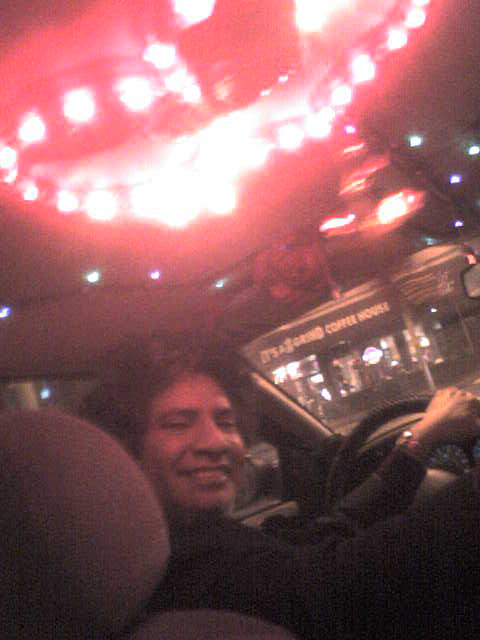
The happiest cab in San Francisco! Possibly the world! I wish I could wake up there on Christmas morning. It’s completely tricked out with Christmas bling. And the driver, my angel, has a coif that would be the envy of any 70’s pimp.

When I got in, Felice Navidad came on the radio. He turned it up.

I said “Are we going to sing?”

He said “Yes, we are.”

And we rolled down the windows and sang at the top of our lungs (he even taught me the Spanish part I never understood). I made him drive around the block until the song ended. I was sad when it did.


Nov 26 2011

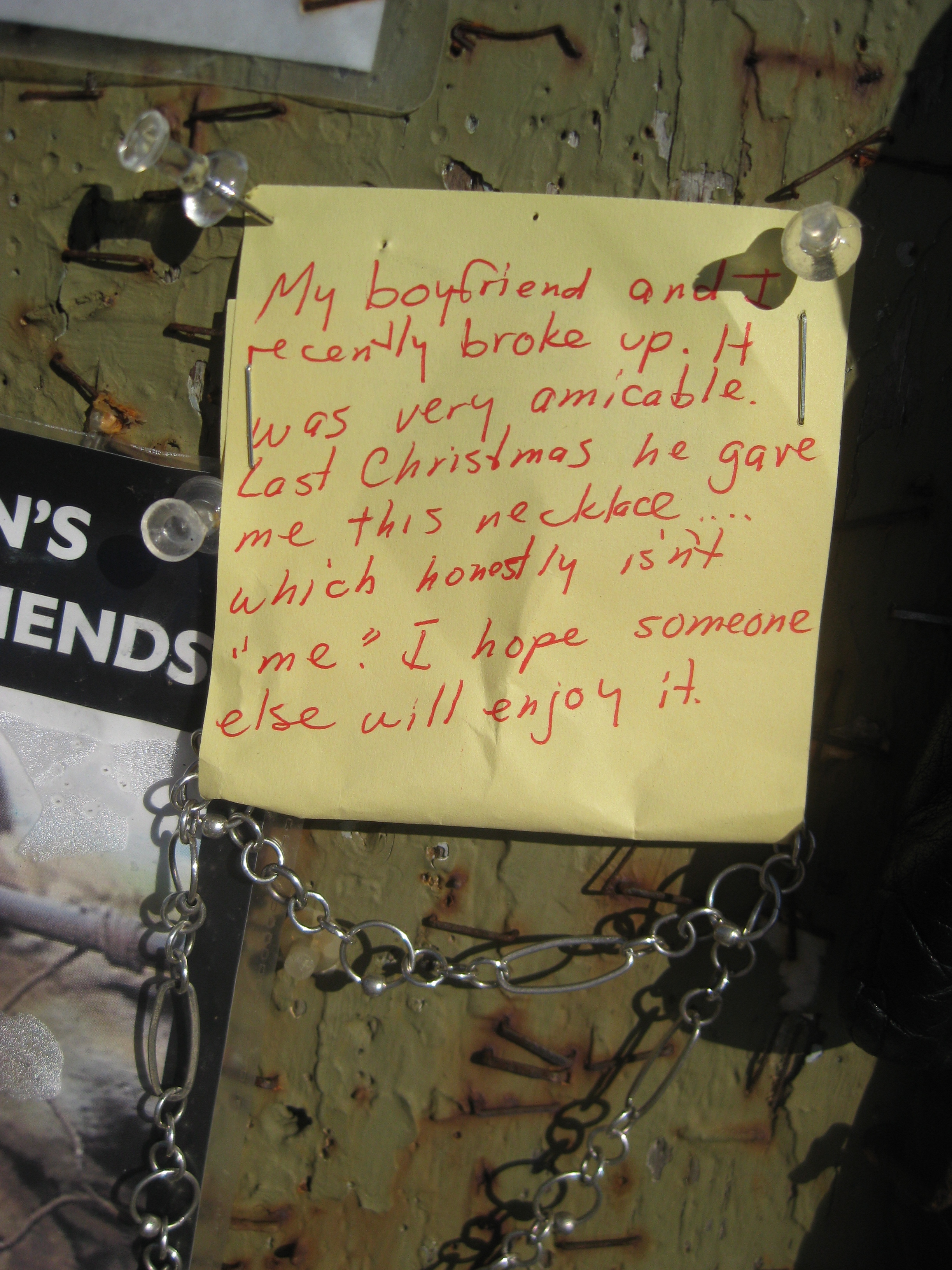
Because Some Objects Deserve Fresh Starts As Much As People Do.

I posted this on the community board at the beach where I walk my dog. It was gone within an hour. I hope this necklace went to someone who really cherishes it. I cherish the thought and memory behind this necklace, and I’ll always have that.

I love the idea that it found a good home, and that someone out there is really happy to be wearing this necklace.


Nov 24 2011

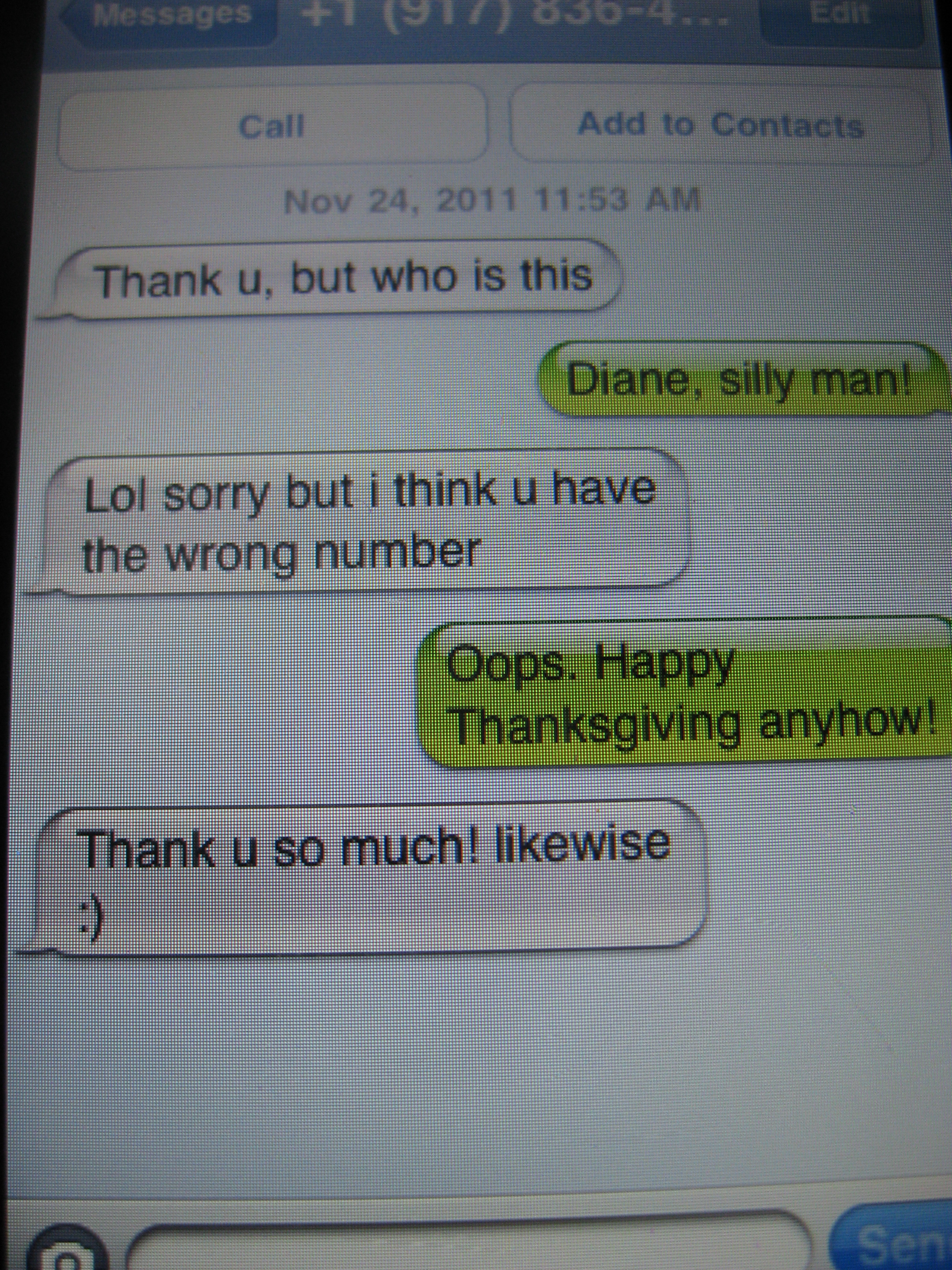
I’m thankful for accidental encounters with delightful strangers.

or "How you know it's time to clean up your contact list."


Nov 22 2011

Welcome Home, Picard.

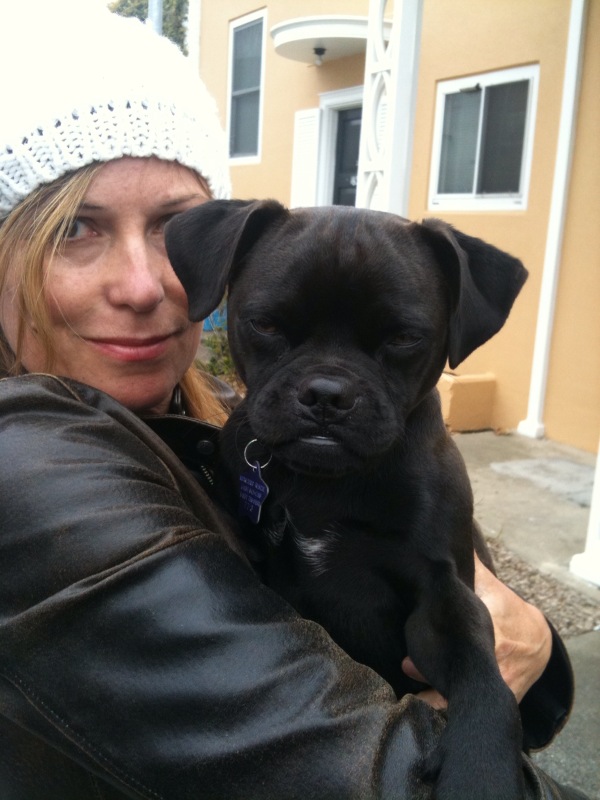
Just moments after our first encounter.

(This story can also be found in the print and online editions of Bay Woof magazine.)

I used to be a fairly regular blogger; just another person with a greater than average need to express myself – usually as a means to make sense of life, especially when it confounds me (and there was a lot of that these past few years). But then something happened: I got a dog. Coincidentally, I got a boyfriend at roughly the same time. So basically, I got a life again. And so for the past year, while I’ve been enjoying living this life, the only things I’ve posted on my blog are cute pup pictures.

So how did I so completely and quickly morph from the creator of “The Adventures of Vulva Fervor” into this googoogaga-ing mommy creature — the kind that thinks her dogs yawns are adorable and his stinky puppy breath is wonderful and the way he whistle-woofs in his sleep is just the cutest darned thing, not to mention the way his ass shoots up in the air when he shakes — that I used to mock?

Let’s start with the obvious: I’m 47, with no children. And at this point in life, it looks like I’m not going to have ’em. Despite great health and all the energy in the world, that’s just the cold hard truth of my reproductive cycle. Though I never truly had that strong baby urge, I always assumed I’d have at least one child. A daughter. And since my own mother died when I was young, leaving me with many unanswered questions about who she was other than my mother, I have a trunk full of memorabilia, journals, etc – a trunk full of young me – for my daughter, should I leave her too early. Now with no daughter, I don’t know what the hell to do with this trunk now. But I digress…

I didn’t plan on owning a dog; I went to a Rocket Dog Rescue (RDR) adoption event to foster a pit bull for two days (an idea that was inspired by  another writing project of mine, “The Saga Of Gray And Nameless”).  RDR didn’t have any pitties that day. But since I’d driven all the way out there, I might as well foster something until a pittie came along. As I live in a tiny city flat with thin walls, a quiet dog was necessary. Problem was, all the quiet dogs seemed nervous, if not downright terrified. Except one: a funny-looking 6-month old pug mix named Picard who seemed uniquely independent, calm and almost aloof. I had no other choice.

That night I hosted a Mad Men season 4 premiere cocktail party for 12 guests. Picard was calm with a houseful of strangers, and never made one move toward the table covered with hors d’oeuvres. He needed nothing more than a lap on which to lay his head. He almost seemed hesitant to trust this happy home, as if he didn’t want to get attached. But… I got attached. Despite no job and no money, I had to find a way to keep him. I needed to take care of him, and would do whatever I had to do to give this little guy a happy home and make him feel safe and loved. And somehow, it just happened. After jobhunting for two years, I finally got a job.

Now, every day I wake up to a face that is pure happiness. Happy to be awake and know that breakfast is coming soon… though sometimes not soon enough. One morning I was sleeping in uncharacteristically late, and Picard woke me up by licking my eyelids open. Point is, his pure happiness is pure inspiration, from the second I open my eyes.  You can’t wake up in a bad mood with Picard in the room. On that note, no matter how bad a day I’ve had, I can’t stay in a bad mood when I come home to him. He’s so happy I’m home. It truly grounds me, how lucky I am to have a home and to have him in it. Then there’s the sheer joy he has in simply walking outside. Same route, different route, doesn’t matter; he’s outside and walking in the world, a part of it. He doesn’t consider his place in the world, where he’s come from or where he’s going. He’s just so damn happy to be moving and seeing people and sniffing things and meeting other pups. A fine example of living in the moment.

Picard has also reminded me of aspects of myself that I’d forgotten. For example, as a kid I was a huge lover of the outdoors: a Girl Scout, a camper, a hiker, a skier, a skater, a climber. I have 2 olders brothers, and I was always tagging along on their adventures (as much as they’d let me). Now as a car-free urbanite, I keep my outdoor activities to  simply hiking the hills of San Francisco — that is until I got Picard. He has so much energy (which he contains magnificently when in my flat), far more than he can burn off in a day walking or running with me. So at least once a week, we head out to Ft. Funston or Lands End or hunt for new places where he can run himself silly. And I feel like my face is going to crack from smiling so hard when I watch him run! When he runs, it looks like his eyes are going to bulge out of his head from all the joy. Thank you, Picard, for resurrecting the nature lover in me.

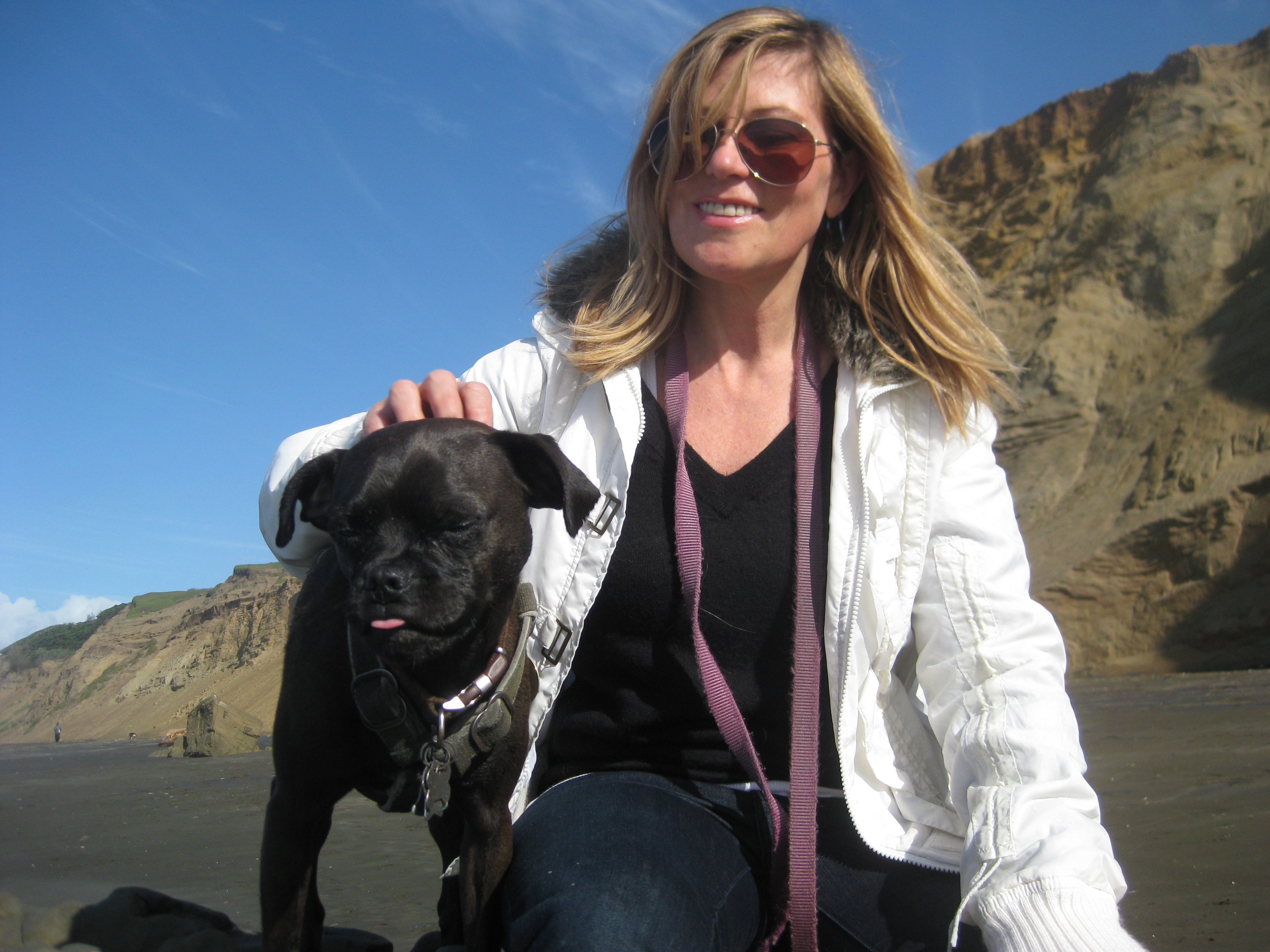
Picard keeping Pauline from her work! (please pardon the “lipstick.”)

He’s also a great listener. He knows that it’s best not to say too much; that I really just need him to listen, be my sounding board. He listened when I told him about the recent split between my beau and myself. And Picard made me realize that any pain I felt in that split was a fraction of what I would feel if I had to part with Picard. I don’t know if that’s very telling about the relationship, or if it’s more telling that this is what I need in my heart right now: to be a “mother,” rather than a partner. What I do know is that what makes my relationship with Picard one that most romantic unions might want to emulate is that it is balanced. He gives to me as much as I give to him. Of course his giving is pure and mindless and effortless, which makes it all the sweeter. And he gives to others as well: Picketers put down their signs to pet him. Handsome manly men cross the street to meet him (lucky me!) In stores, mothers take their babies out of their strollers so they can kiss him. Business comes to a standstill when I bring him on errands with me. And no kidding, I can’t tell you how many people have thanked me for sharing him. I feel so, so blessed that I get to witness and experience the joy he brings to others every day, simply by being delightfully sweet and loving. I truly believe he is the key to world peace: If you locked all oppressors, bullies, and sadistic motherfuckers in a room with Picard, I know for a fact he could disarm them all.

People come and go, sometimes breaking our hearts. But the little ones, the dogs and cats and pre-verbal children… they bring out the good in us and others they encounter. I know that having a dog is not the same as having a child. But it’s what I’ve got to work with, and there are  ways in which having a pup is advantageous to having a child at this point in my life. I will always be able to pick up and hold Picard, something that children outgrow both in size and in their tolerance for being kissed to the point of embarrassment (also something that gets difficult to do as we get older). Picard will not cost me a fortune in college tuition, he will never talk back to me, and he will never introduce unpleasant friends into my home. Added bonus: he rarely, rarely tests me.

At our favorite spot: Ft. Funston.

I’m just the lucky lottery winner who happened to be in the right place at the right time when this pup needed a home. Home is one of the most sacred words — and things — in the world to me. Picard reminds me every day of how important it is to feel safe and secure in the knowledge that you have a home – whether that be a physical place or someone  that will always protect and provide love and safety and comfort. I’ve learned that it’s indescribably satisfying to give someone — even a dog — a home. Far better than receiving one. Welcome home Picard.